




Funerals around Christmas Are Different — Emotionally and Practically
Filed under:
Christmas is a time we’re told should be filled with connection, tradition, and familiarity — a season of togetherness. But when someone dies at this time of year, grief doesn’t pause out of respect for the calendar. Funerals at Christmas are different, both emotionally and practically. They carry added weight, tighter timelines, and a complexity that isn’t always visible from the outside. This is a reflection on one such funeral, and on what it asks of families — and those who support them — at a time when the world keeps insisting on celebration.
Getting asking to be a Celebrant for a Funeral around Christmas
Two days after I arrived back in Australia — after my father’s memorial in Tenerife — I received an Instagram message from Lauren.
I married Lauren to her lovely husband Neil a few years ago and we’ve stayed in touch over socials. Only a few months earlier, I had stood with her family again, this time to farewell her Mum, Pat. Now Lauren was reaching out to tell me that her Dad Glyn had died that day, and asking if I would be the family’s celebrant once more.
That was on 22 December, and Lauren and her sister Alicia were hoping to hold the funeral on 28 December — not much time for anyone involved: the funeral directors, the printers, or me.
As I often do, I gently encouraged Lauren and Alicia not to rush. There can be a sense of misplaced urgency when someone dies — a feeling that the service must happen immediately. In reality, families usually have more time than they think, and a little space can sometimes make the planning easier.
But Lauren and Alicia explained something important.
For them, it mattered deeply that their Dad’s funeral was held in the same year as their Mum’s — in 2025. They didn’t want to carry this loss over into 2026, to have another year defined by endings. They wanted, as much as anyone can, to contain the grief somewhat within this year rather than let it become the opening chapter of the next.
I understood that instinct completely.
And honestly, how could I say no to a family I felt so connected to — a family asking not just for a celebrant, but for someone who already understood their story.
The timing, on paper, wasn’t ideal. I hadn’t worked properly in my business for around three months and had a lot to catch up on. Plus I was still navigating my own grief after my father, Ogmore, and step-father, Jimmy, died in quick succession. I had planned a quiet week over Christmas — a gentle recalibration before a calendar full of weddings kicked off with a micro-wedding on 1 January.
Before I said yes, I asked my husband for his advice. I knew I wanted to do the funeral, but I also knew what it would mean: working through Christmas, maybe not on the day itself, but in the days before and after. No Christmas shopping. No time to think about traditions. Very little headspace.
He encouraged me to do it. He took on all the home responsibilities, all the Christmas logistics, so that I could focus fully on the family who needed me. I don’t take that kind of support lightly — my husband Cameron is a legend.

Returning to a Place No One Wants to Revisit
For Lauren and Alicia, this meant returning to a space they never expected to revisit so soon.
Once again, they had to make decisions, have difficult conversations, and hold everything together — all while quietly carrying their own heartbreak.
They did this while also being mothers and partners. They carved out time away from their own families in Christmas week so that this service for their beloved father, Glyn, could be what it needed to be. That is love in action, even though it costed them dearly.
The silver lining, they knew me — and how I work. There was no formality this time. We jumped straight into collaboration mode starting a new Whatsapp chat. Having planned their mother’s funeral only months earlier, they knew what to expect and were able to focus on the practical to‑do list of funeral planning: music, readings, photos, words.
The Timing of a Death or Funeral around Christmas
And then there was the timing of this loss.
Christmas is meant to be a season of gathering, of familiarity and tradition. I felt it was important to acknowledge during the ceremony opening that when death arrives at this time of year, it casts a longer shadow. It doesn’t just affect that Christmas — it reshapes the ones to come. Future Decembers will arrive carrying memories, absences, and those quiet moments where we think about who is not sitting at the table.
Another very real layer of complexity was logistics. Christmas closures meant Lauren and Alicia’s timeline was compressed in practical ways — particularly around the printer’s opening hours for the Order of Service. Decisions about photos, music, readings, and ceremony elements had to be made more quickly than they normally would.
That kind of compression can add stress at a time when families are already emotionally stretched. But because we talked about it openly from the start, we all knew what we were saying yes to. Expectations were clear. It didn’t make the process easy — there were several very late nights — but the focus never wavered.

The Ceremony
Glyn’s funeral service was held at Greenway Chapel, Green Point, a beautiful, calming, bright chapel with large windows overlooking a woodland. It was the same place that Pat’s funeral had been held — both comforting and triggering for the family.
The girls decided they didn’t want to greet all their guests on arrival. They chose to walk into the chapel after the guests were seated. Before they walked in, I held their hands, invited them to close their eyes, and take a few deep breaths to centre them.
We divided the eulogy into parts. I took care of the logistical story of Glyn’s life — his early years, career, travels, sport, marriage, and the communities he was part of. Lauren and Alicia focused on who he was: his values, his attributes, his role as their father, the stories that only daughters can tell. It required close collaboration and careful planning to avoid overlap. We worked on our speaking parts up until the morning of the funeral, but the result was worth it: a deeply moving tribute. Is it weird to say that I am so proud of them for how they spoke during the service?!
At the end of the ceremony, the family, followed by everyone else, approached Glyn’s coffin to say their final goodbyes. White rose stems were provided for guests to place on the coffin as they left, a simple but powerful gesture. Each rose carried a piece of memory, love, or gratitude — a quiet offering of respect and farewell. Moments like these allow everyone to pause, to connect with their own grief, and to honour the life that has touched them. There’s something profoundly human about this act: it transforms goodbye from a word into a tangible, shared experience. In that still, gentle moment, grief and love coexist, creating space for both remembrance and release.
The Open Mic
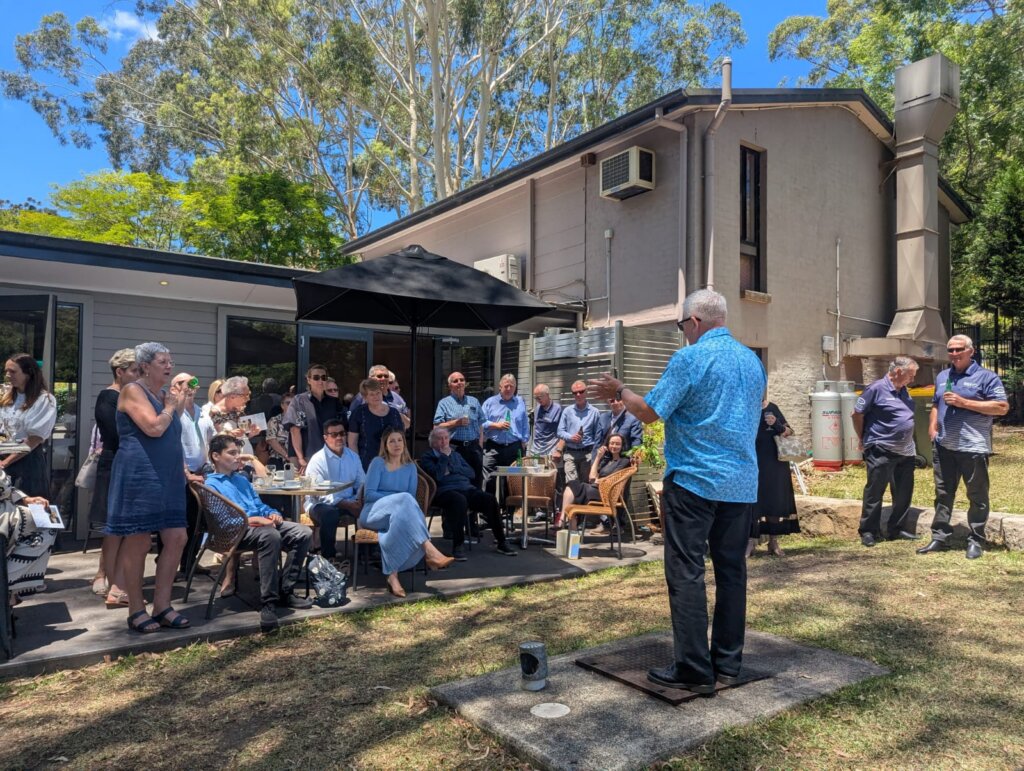
It’s impossible to sum up a whole life in the time of a funeral service — so after the ceremony, everyone was invited to the function room garden to continue the storytelling in a relaxed, informal way: an open mic, a drink in hand. We called it Glyn’s ‘last shout’.
Storytelling is where the magic happens. Each memory shared — a funny anecdote, a heartfelt moment, a quiet reflection — brought Glyn vividly back into the room in ways no eulogy alone could. His grandchildren’s voices added a fresh, unfiltered perspective, weaving new threads into the portrait of his life we had begun during the ceremony. In this space, grief and laughter sat side by side, and the farewell became more than a single moment: it became a living, breathing celebration of a life well-lived.
Why This Matters
This funeral reminded me why flexibility, trust, and relationship matter so much in this work.
There is no single right way to farewell someone. There is only this family, this moment, and what feels true and supportive for them.
Sometimes that means slowing things down. And sometimes — like this — it means stepping in, even when the timing is hard, because compassion and connection ask us to.
I will always be grateful to Lauren and Alicia for trusting me again, and for allowing me to walk beside them through another chapter they never wanted to write.
If you’re navigating a loss — especially at a time of year that already carries so much weight — please know that you don’t have to rush, perform, or do things any particular way. You’re allowed to choose what feels right for you and your family.
That, too, is love in action.

My Reflections
After Glyn’s funeral, I felt as though I’d been hit by an emotional truck — my limbs ached, and getting out of bed felt impossible. That kind of heaviness is sometimes par for the course in this work, and it doesn’t lessen my commitment to funerals. Lauren gently asked if my own recent grief had been stirred and whether it might change whether I continue to offer funeral celebrancy services. The answer is simple: it only deepens my resolve. This work is profoundly meaningful, and having navigated the loss of two parents myself, I bring an even greater depth of empathy and understanding to the families I work with.
Review
Being appreciated for my work is always moving, but it’s never something I expect from the families I support. When people are grieving, they already have more than enough to carry, and I’m deeply mindful not to place any additional emotional expectations on them. They engage me to walk alongside them and to do my job well — praise or recognition is not required of them.
When we met to plan the funeral, Lauren and Alicia brought flowers and Christmas gifts to acknowledge the care, effort, and personal sacrifice involved in being a funeral celebrant around Christmas. For them to be so thoughtful amidst their grief was incredibly touching and something I will never forget.
“Our beautiful Jules,
Thank you so much for the incredible effort you put in for today, we feel such gratitude and appreciation.
What you created for Dad was so much more than an end of life ceremony. You acknowledged our grief with such tenderness and strength, and you honoured his life in a way that was so meaningful, and what you wrote and delivered really honoured him and was such a gift.
You have made such an extraordinary effort and commitment by taking us on. Such time and sacrifice away from family at Christmas time. While also carrying such profound loss, having lost both your dad and your stepfather, and this being your first Christmas and being your first funeral after being a guest yourselves in the front row. Please know that this is not lost on us for a second. To show up with such generosity of spirit, compassion, and love while holding your own heartache speaks volumes about the extraordinary person you are.
We are beyond grateful for the care, warmth, and sincerity you poured into every word and moment. Thank you for supporting us on one of the hardest days of our lives and for doing so with such grace. I wonder if you will lean out of funerals or lean in — either way you know your career path is one that makes such an impact, having you lead Dad’s day propelled our worst day into much more bearable territory. Also that hand-holding, grounding moment before we walked in yesterday, was needed more than you know. You are so impactful and so important to us.
With all our love, respect, and appreciation,
Lauren & Alicia”
Funeral Vendors
Creightons | Greenway Chapel | Julie Muir Celebrant | Florist | Printer
As a funeral celebrant and death doula, my work sits at the intersection of grief, love, and practical support. I walk alongside families not just on the day of a funeral, but through the conversations, decisions, and quiet moments that lead up to it. Whether a death arrives suddenly or after a long journey, at Christmas or any other time of year, my role is to hold space with care, honesty, and compassion — and to help families create farewells that feel true to them. If there is one thing I’ve learned, it’s that being gently supported through loss can make even the hardest days feel a little more bearable.
| |||||||||||||||||||||||